NIST26 Tandem Mass Spectral Libraries
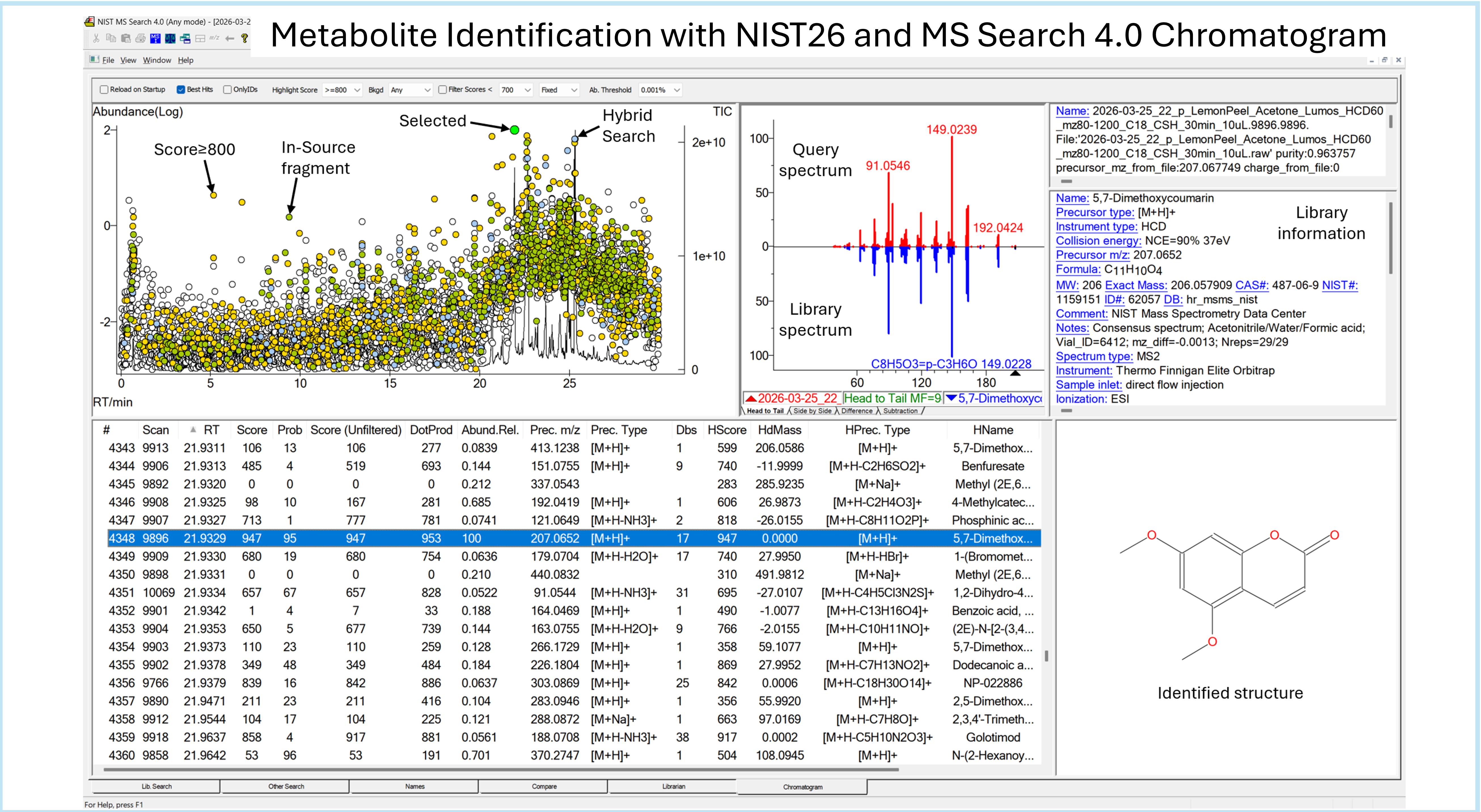
This webpage highlights the key features of the NIST26 Tandem Mass Spectral Libraries. These libraries provide high-quality, comprehensive spectra of analytically important compounds and are widely used for compound identification in metabolomics, food science, health, agriculture, environmental research, pharmaceuticals, forensic studies, etc.
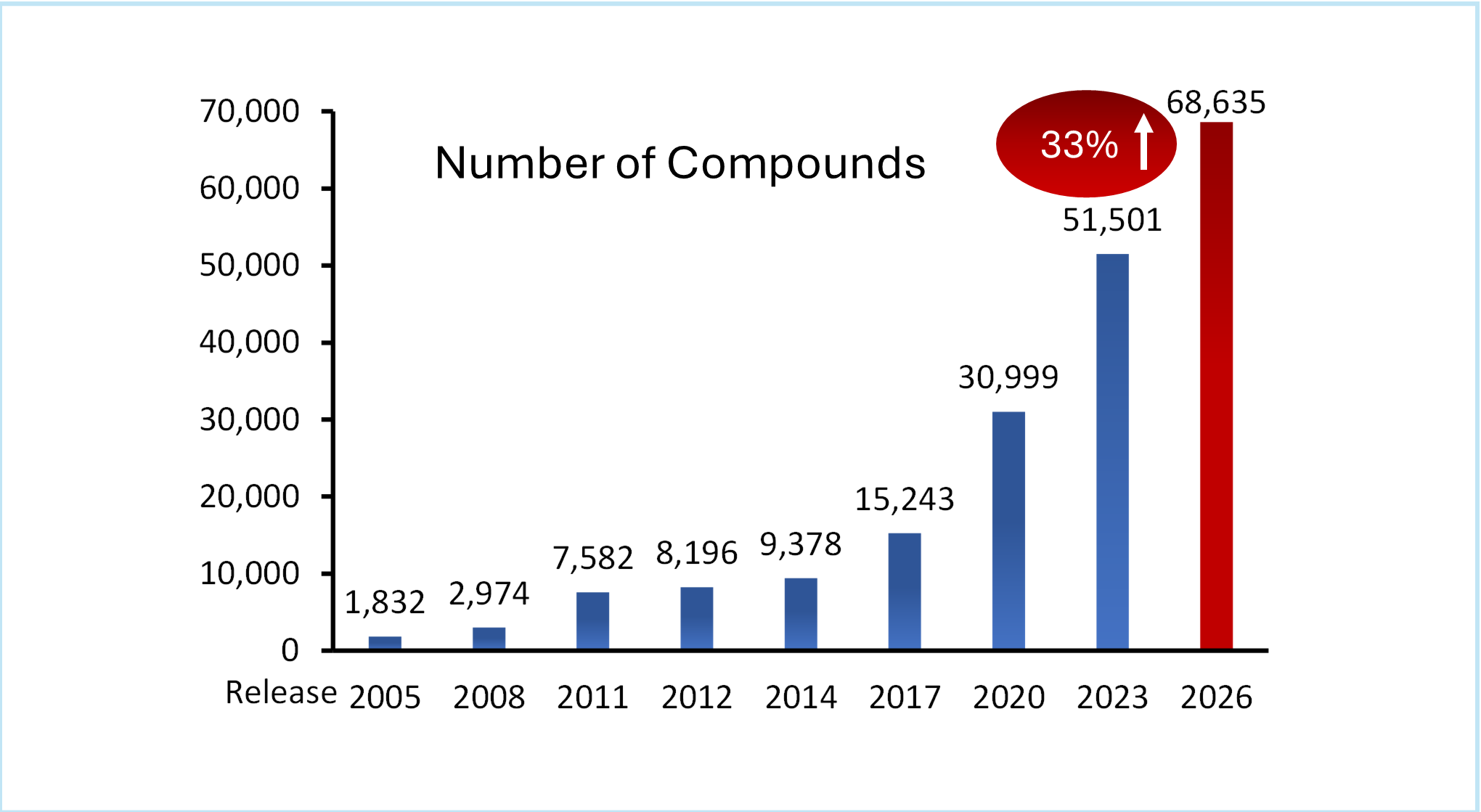
- 68,635 compounds 33% increase over NIST23!
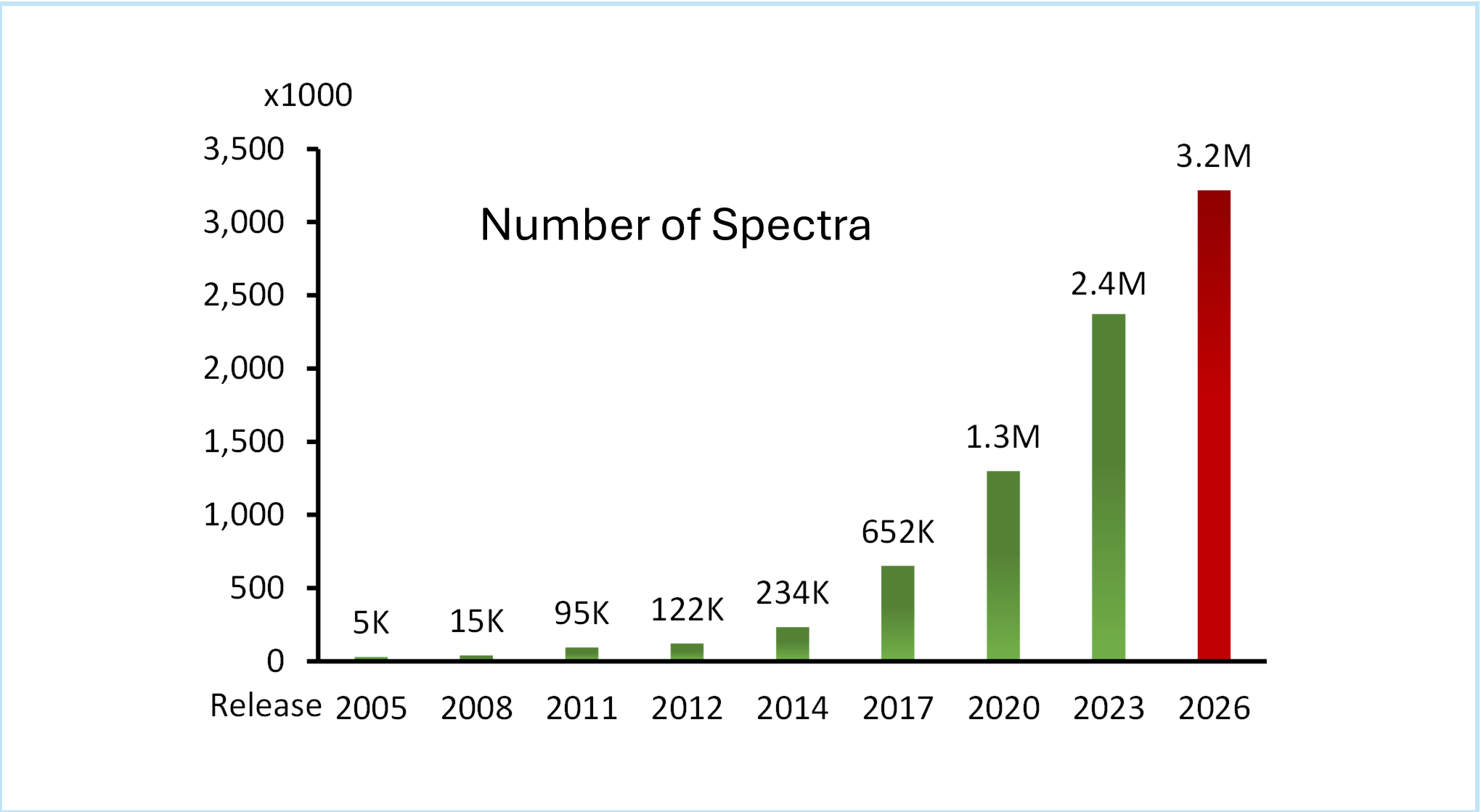
- 3,219,115 tandem spectra with a wide range of fragmentation conditions including positive and negative modes from ion-trap (up to MS4) and ‘beam-type’ collision cells (QTOF, HCD, and QqQ); new spectra acquired at high accuracy and resolution
- 567,114 precursor ions including in-source fragments
| Library | Instrument Type | Compounds | Precursor Ions | Spectra |
|---|---|---|---|---|
| Small Molecule HRAM1 MS/MS Library (hr_msms_nist) | Beam Type Collision Cell | 66,282 | 211,814 | 2,347,204 |
| Ion Trap | 63,198 | 268,484 | 291,845 | |
| Small Molecule Low Resolution MS/MS Library (lr_msms_nist) | Beam Type Collision Cell | 3,346 | 5,750 | 64,111 |
| Ion Trap | 65,857 | 455,057 | 509,562 | |
| Small Molecule APCI2 High Resolution MS/MS Library (apci_msms_nist) | Beam Type Collision Cell | 623 | 1,339 | 6,403 |
| All | Beam Type Collision Cell | 67,382 | 215,029 | 2,417,718 |
| Ion Trap | 66,430 | 542,389 | 801,397 | |
| Total | 68,635 | 567,114 | 3,219,115 |
1 - HRAM: High Resolution Accurate Mass.
2 - APCI: Atmospheric Pressure Chemical Ionization; for extractable and leachable compounds.
Most Common Precursor Ions
Positive Precursors:
[M+H]+, [M+H-H2O]+, [M+Na]+, [M+2H]2+, [2M+H]+, [M+H-2H2O]+, [M+H-NH3]+, [M+NH4]+, [M-H+2Na]+, [M+K]+, [M+H+K]2+, [M+H+Na]2+, [M+2Na]2+, [M-2H+3Na]+, and others
Negative Precursors:
[M-H]-, [M-2H]2-, [M-H-H2O]-, [M+Cl]-, [M-H-CO2]-, [M+HCO2]-, [2M-H]-, and others
| • 77% positive mode, 23% negative mode |
|---|
| • In-source Fragments (50% of the spectra) |
| • MSn (13% of the spectra) |

The NIST Tandem MS Library and Search Program is available from these distributors
 Home
Home  Content
  Team
Team
 Contact Us